LA TEORIA
DEL VUOTO
Tommaso Bonaventura
Alessandro Imbriaco
Fabio Severo
la teoria del vuoto
bonaventura imbriaco severo
Via Salieri1, Buccinasco, 2012. Two men walk their dogs along the pavements that run on either side of a road. It is a road like many others, in a town like many others, in a hinterland like many others, on a day like many others. The image conveys the familiar routine and the urbanised vacancy of any provincial place. Few figurative clues: a recent apartment block seen at an angle, trees in the background, the road bending away past the edge of the frame, two dogs seeking each other out. Scant presences, ordinary witnesses of space, of nothingness. One of the great achievements physics reached over the course of the twentieth century was to demonstrate, without fully grasping its dynamics, that nothingness does not exist, or rather that the void is not truly empty. Inside it live incessant quantum fluctuations capable of producing energy even in the absence of matter, continual changes of state that generate particles and antiparticles. The perturbations that arise in the void are unpredictable, and physics hypothesises that they may give rise to a repulsive force of exponential order, with a direct consequence on the formation of cosmic structures and of dark energy. In 2004, near Via Salieri, two rocket launchers were found that were meant to blow up the car of Alberto Nobili, deputy public prosecutor in Milan and a leading figure in some of the most important anti‑mafia investigations conducted in the Lombard capital from the 1990s onwards. Buccinasco is also one of the strongholds of the Barbaro and Papalia ‘ndrine, part of the expansion of the ‘ndrangheta into the north2. Having abandoned the season of terror, mafia organisations have adopted a low‑tension strategy, operating more and more often through activities that leave no traces, laying the legal world over the illegal one, mixing violence and finance, the visible and the invisible. From a technical point of view we consider photography a particular kind of imprint, and the different ways in which an imprint manifests itself are responsible for the working and the production of meaning in an image. An imprint needs ground, a substance and an expression, a visible trace. In the absence of a body, surrounded by a void that hides its own density in perfect transparency, the photographic medium goes into crisis and generates a hyperactive immune response. The result is bulimia, the proliferation and multiplication of images. Hundreds of photographs that measure, analyse, dissect and survey, committing themselves to the futile attempt to circumscribe and define the invisible. One has to drill through the asphalt of Via Salieri to give the image substance again and travel back up the current of information. And dig. Dig through the records of the municipal administration of Buccinasco, dig through the thousands of pages of the ruling in the Nord–Sud trial, dig through the papers that tell the story of the Yugoslav‑made rocket launchers, dig into the words of researchers and sociologists, dig further still to trace a line connecting Buccinasco to Platì, in Calabria, and to its immense system of tunnels and bunkers, discovered on the night of 12 November 2003, which led to the arrest of more than 125 members of the ‘ndrangheta.
1 Via Salieri is one of the images belonging to Corpi di Reato. Un’archeologia visiva dei fenomeni mafiosi in Italia, a 2012 photographic project by Bonaventura, Imbriaco and Severo that explores the Italian landscape as a surface able to preserve the memory of criminal events that have marked and wounded the territory and the collective identity. The project has been shown, among other places, at the Venice Architecture Biennale and belongs to the collections of MUFOCO in Cinisello Balsamo and MAXXI in Rome. 2 The expression ‘ndrangheta al nord refers to the book by Nando Dalla Chiesa and Martina Panzarasa Buccinasco. La ‘ndrangheta al nord, Einaudi, 2012, which was a source of inspiration for the making of the photographic project La Teoria del Vuoto.

la teoria del vuoto
bonaventura imbriaco severo
works
VIA SALIERI, BUCCINASCO, MILAN, 2012. On 19 August 2004, in a wooded area near the municipal allotments of Buccinasco, lying between Via Salieri, Via Archimede and the Tangenziale Ovest, two Zolja M80 64mm rocket launchers were found, one of them armed. At the time of the discovery one of the hypotheses to emerge from the investigation was that the launchers were to be used for an attack on the then deputy public prosecutor Alberto Nobili, one of the leading figures in the fight against organised crime in northern Italy.


la teoria del vuoto
bonaventura imbriaco severo
works

la teoria del vuoto
bonaventura imbriaco severo
installation view
Via Salieri, Buccinasco, Milan, 2012
Inkjet print, 135x180cm

la teoria del vuoto
bonaventura imbriaco severo


la teoria del vuoto
bonaventura imbriaco severo
works
PHOTOGRAPHIC SURVEY OF THE PERIMETER OF THE AREA WHERE TWO M80 ROCKET LAUNCHERS WERE FOUND, BUCCINASCO, MILAN, 2023. The report filed by the Carabinieri of Buccinasco on the discovery of the two Zolja M80 launchers does not make it possible to identify the exact spot where they were found: it does reveal, however, that the place where the previous photograph Via Salieri, Buccinasco, Milano (2012) was taken is in fact hundreds of metres away from the actual area of the discovery. On the basis of information obtained from various sources (police, municipal authorities, newspaper articles) it was possible to narrow the area of interest down to two green areas near the municipal cemetery, covering some 30,000 square metres in all. We therefore decided to carry out a photographic perimeter survey of these two areas, turning our gaze towards the surrounding territory and documenting the urban space that has grown up around them.

la teoria del vuoto
bonaventura imbriaco severo
works

la teoria del vuoto
bonaventura imbriaco severo
installation view
Photographic survey of the perimeter of the area where two M80 rocket launchers were found, Buccinasco, Milan, 2023 2 inkjet prints, 80x110cm each, overall size 200x130cm

la teoria del vuoto
bonaventura imbriaco severo
works

la teoria del vuoto
bonaventura imbriaco severo
works

la teoria del vuoto
bonaventura imbriaco severo
installation view
User manual for the Zolja M80 64mm rocket launcher, Federal Directorate of Supply and Procurement, Yugoslavia, 1982 48 scored inkjet prints, 20x25cm each
la teoria del vuoto
bonaventura imbriaco severo
Camels and bazookas
An old Eastern fable tells the story of three exceedingly clever brothers, sons of the King of the mythical country of Serendip, who are driven out of the kingdom so that their abilities—not only intellectual but also practical—may be put to the test. In the course of their journey, the story goes, the three meet a camel driver in despair at having lost one of his animals. Although they have never seen the animal before, the three manage to describe its features down to the smallest detail: it is blind in one eye, lame and toothless; it was also carrying a load of honey and butter (or, depending on the version, of wine and oil). The camel driver then asks for directions to find the animal, and the brothers tell him they met it further back along the road. The camel, however, is nowhere to be found, and the driver, enraged, denounces them for theft and has them sentenced to death. Shortly before the execution, a different camel driver finds the lost camel, returns it to its rightful owner, and so allows the three brothers to be set free. At this point the question arises of its own accord: how had the three brothers been able to describe so precisely an animal they had never seen before, making fools of everyone? Along the road—the three explain—the grass had been cropped on the worse side, the only side visible to the good eye of a one‑eyed animal, and it had been cropped badly, so the animal must also have been toothless; the tracks, moreover, were irregular, a sign that the animal was lame, and this must have caused honey to spill on one side, where flies had indeed settled, and butter on the other, where ants were walking instead. But what have the three brothers of Serendip to do with the two rocket launchers to which the photograph of via Salieri refers? In 2002, in Buccinasco, the municipality decided to build a playground in the “Spina Verde” area, a strip of land up against the ring road which turned out to be affected by illegal dumping. The firm of one Lorenzo Paolo Quadrio was given the job of clearing away the dumped waste. During the work, however, Quadrio was invited to move to an adjacent plot. Of this “invitation to move” there are at least two versions: Quadrio maintains that a municipal surveyor told him, once the work had begun, that the completion of the job fell to a firm connected to Salvatore Barbaro, a local businessman of Calabrian origin, and that he was instead to clear a different
plot; a municipal official maintains instead that it was Quadrio himself who fearfully gave up the job, driven off by threats from Salvatore Barbaro in person. Quadrio’s work ended in September 2003, but on 26 March 2003 the car of the then mayor of Buccinasco, Maurizio Carbonera, had already been set on fire, and on 12 October 2003 that of Simone Bicocchi, the owner of the firm that had won the contract to build the playground, would be burnt in turn. On 19 August 2004—in the course of a different job—Quadrio’s company was clearing an area not far from the previous one (between via Salieri, via Romagna and via Archimede) when the excavator struck what an inexpert eye might have taken for a simple pipe: it was in fact a rocket launcher. The Carabinieri were called in; they identified the object, called in the dog units and, between the evening of 19 and the morning of 20 August, found a second launcher: the first was armed (the rocket was inserted in the tube), the second was separated, the rocket on one side and the launcher on the other, in a green bag. The two launchers were seized and the record of the seizure was produced during the “Cerberus” trial, which dealt with the infiltration of the ‘ndrangheta into the earth‑moving sector of the Milan hinterland. When the launchers were found, the investigation that would later lead to the trial had only just begun. The “Cerberus” trial ended on 10 January 2018, after two remands by the Court of Cassation, convicting—among others—Salvatore Barbaro of mafia‑type criminal association. Through various acts of intimidation the firms connected to Barbaro had imposed their indispensable presence on the property works put out to tender by the municipality, thus creating a condition of near‑monopoly in the sector: they dictated market prices and had in effect taken possession of the whole earth‑moving business south‑west of Milan, able therefore to count—if not, at times, on the compliance of certain entrepreneurs—on the subjection and the silence of competing firms and of municipal administrators. The mental route that took the investigators from the launchers to the mafia is, as can be seen, the same that took the three brothers of Serendip from the cropped grass to the camel. It is one of the oldest activities in which human beings have engaged while, in the thick of the undergrowth, they “decipher” the traces left by their prey: «to work back from apparently negligible
by Valerio Aiuti
Valerio Aiuti—Researcher in Criminal Procedure at
Sapienza University of Rome
la teoria del vuoto
bonaventura imbriaco severo
experimental data to a complex reality that cannot be experienced directly […] in such a way as to give rise to a narrative sequence, whose simplest formulation might be “someone passed by here”». There is a problem, however, that concerns camels and bazookas alike. When the traces whose origins we wish to know cannot be referred back to empirical realities that can be reproduced at will (as happens instead with scientific experiments), the rigour of the narrative sequence, that is its capacity to represent the past faithfully starting from the present, is caught in a fatal paradox: either we account for every smallest detail connected with those traces, thereby severing them inexorably from any rule able to explain and encompass them, and their first cause will in the end prove inscrutable (this is the case with the so‑called “idiopathic” diseases, which have no known cause and therefore resolve into the minute diagnosis of a “private suffering”, ἴδιος πάσχειν); or we sacrifice some detail, disregarding differences in order to concentrate instead on similarities with other traces already observed in the past, and sooner or later we shall be able to bring them under a common rule which—by virtue of a more or less solid generalisation—will offer us an explanation of that kind of phenomenon. When a public prosecutor charges a defendant with belonging to a mafia‑type criminal association, he is required to prove that, together with at least two other people, the defendant availed himself of the “force of intimidation” produced by the existence of that association, thereby creating a condition of “subjection” and “silence” in a more or less wide body of individuals, in order to acquire the management or control of economic activities, concessions, authorisations, contracts and public services, or in order to obtain unjust profits or advantages for himself or for others, or again in order to obstruct the free exercise of the vote, or to secure votes for himself or for others during elections (art. 416–bis, paragraph 3, of the criminal code). It is not necessary that the management, profits and interference (the so‑called “target offences” of the association) should also have been concretely established: participants are punished by law for the mere fact of belonging to an association of this kind. What is certainly necessary, instead, is to prove the “force of intimidation” that produced the “subjection” and the “silence”: this is the core of a criminal charge of this kind, the so‑called “mafia method”. Through
it, this kind of criminal organisation engages in that particular trading of social capital whose best‑known manifestation lies—for example—in protection money: the “control of the territory” usually associated with the mafia is in fact produced through a perverse exchange between protection (offered by the organisation) and subjection (which that very offer induces in those who receive it); by extorting, the association protects (or—if one prefers—by protecting, it extorts), and so creates that network of relations which constitutes its first and most authentic source of wealth (quite apart from the lawful or unlawful activities it will then actually pursue). When, on the other hand, a defence lawyer argues that his client does not belong to a mafia association, he may for instance try to show that the acts of intimidation could not be referred to that association at all, which is therefore—at most—a simple criminal association (art. 416 of the criminal code), one that does not avail itself of that very particular method. The public prosecutor, in short, tends to sacrifice the particularities of the single events he wants to establish in order to bring them under a rule that explains a vast portion of reality in the terms in which the concept of “mafia‑type criminal association” defines it; the defence lawyer, instead, aims to accentuate those particularities and differences, with the precise purpose of ruling out that those events can be referred to the offence we commonly call “mafia”. In the first‑instance judgment of the “Cerberus” trial, the discovery of the rocket launchers was at first counted among the intimidatory acts capable of demonstrating that typical “force” which the Barbaro ‘ndrina was said to have used, inducing subjection and silence in the businessmen and the public administrators of Buccinasco. In the course of the hearings—however—the launchers slipped into the background, never to be recalled again in any of the subsequent (six) stages of judgment: the discovery only helped to rule out that the Barbaro ‘ndrina, whose existence would instead be judicially established, was an “armed” ‘ndrina (art. 416–bis, paragraph 4, of the criminal code). Probably, however uncommon it may be to find two rocket launchers in a ditch, it was not a matter of great importance in the economy of the “Cerberus” trial. The intimidations from which the “force” of the Barbaro ‘ndrina was said to stem were held to be inferable from other facts, more significant ones, or ones more readily referable to the role that the Barbaro had carved out for
themselves in the Milanese earth‑moving sector. Thus, since no one has ever been able to connect those rocket launchers to the single association headed by Salvatore Barbaro, that single fact—however surprising—has remained confined among the individual events that cannot be referred to any regularity or encompassing explanation: we have some disturbed grass, but we are not even able to say whether it was really cropped.
is not there (this is the case with the pareidolic illusions into which the observer obsessed with the Shroud of Turin falls). The public prosecutor, for example, often risks taking for a causal correlation the merely accidental presence of features shared by different phenomena: where there is a certain criminal association there are likely to be military weapons, but the converse is by no means true (heavy weapons are held by criminal associations very distant from one another, running independent traffics, and heavy weapons are also held by the army, for instance). It is a practice we certainly cannot retrace here for judicial reasons, but whose recursiveness and pervasiveness we can observe: it is a recursive practice because it operates in the initial referral of the launchers to the conduct of the Barbaro, but it operates also in the subsequent referral of the Barbaro organisation to a mafia‑type criminal organisation, albeit one present in a so‑called “non‑traditional” territory such as—at the time—the Milanese hinterland; and it is a pervasive practice because the discovery of the launchers is continually transformed, from the intimidatory fact in which the “mafia method” of the Barbaro supposedly consisted, into an aggravating circumstance of the offence (later ruled out), and then into a procedurally irrelevant element in the “Cerberus” case, yet—circulating in trials other than “Cerberus”—into a relevant one in the reconstruction of facts very distant from Buccinasco in history, geography and dynamics, connected to one another only by the fact of having been committed in the context of ‘ndrangheta wars.
2. Meta–metonymies In the art of hunting, as in medical science and in jurisprudence, the relationship with the individual fact that must be brought under a general rule is often a tormented one: with what certainty can one say that this trace is the consequence of this antecedent, and that it is not instead possible to imagine other, equally reasonable antecedents that might have produced it? Was the grass cropped by a camel or by a sheep? Did a troop of soldiers pass and trample the meadow? The rhetorical figure that governs the reconstruction of a past event no longer directly experienceable is therefore metonymy, the part for the whole. In a trial, too, the point is to establish whether the “whole” laid down by the incriminating provision can reasonably be inferred from the “parts” gathered by the public prosecutor: do the rocket launchers amount to an act of intimidation which Tom, Dick and Harry availed themselves of, producing subjection and silence, for their shady ends? Or, considering that they were found underground, after digging, only partly assembled, in an area up against a ring road, might they have been dropped (or perhaps hidden?) by someone passing that way some time before? The practice of metonymy thus leaves the interpreter a certain room for manoeuvre: limited room (it is only by virtue of his prior knowledge that he can build a more or less solid generalisation, able to refer the part to the whole), but rich in opportunities (the impassable frontier of the imagination is only that of the reasonable and the mundane, since the launchers certainly cannot have materialised in a ditch as if by magic). This practice is influenced, obviously, by the idiosyncratic points of view of those who observe the traces, and who, once attached to an idea, risk “seeing” even what
3. Local mafias, global mafias The investigations of the “Cerberus” trial began shortly after the car fires mentioned above. In referring them to a comprehensive criminal hypothesis, the investigators had to face a well‑known legal difficulty: how can the existence of an ‘ndrina be established in a place other than Calabria? The question already conceals a prejudice (why should we think of an ‘ndrina at all, if a car catches fire in Buccinasco?), warranted at the time by the “criminal fame” the Barbaro enjoyed by virtue of their family tie with the Papalia (Salvatore is in fact the husband of Rocco Papalia’s daughter), one of the best‑known Milanese ‘ndrine broken up by the “Nord–Sud” trial10. The same question then carries a rather obvious warning: one cannot expect the sociological reality
la teoria del vuoto
bonaventura imbriaco severo
with which such demanding trials deal to be completely “captured” by the meshes of the law, which is obliged to work with very precise legal rules whose occurrence it must establish in concrete cases. The provision that punishes mafia association thus orients the ascertainment of the facts that might demonstrate the occurrence of the offence, selecting in advance those that may concern the trial and those which—even if sociologically significant—turn out to be legally irrelevant; but the ascertainment of certain facts with which the trial inevitably ends up dealing also draws certain events into the field of application of rules other than those we had initially imagined11: a trial concerning a simple extortion may turn, as the facts underlying it are made more precise, into an important mafia trial. The point of view from which one can reflect on the discovery of the rocket launchers is therefore a somewhat narrow one, but it allows—ironically enough—a few scattered clues to yield the fundamental features of far broader cognitive practices. The occurrence of mafia‑type criminal organisations in so‑called “non‑traditional” areas, in particular, presents at least three orders of difficulty, according to the literature. In the first place, it is a well‑known sociological fact that the internal migration of the 1960s and 1970s favoured, sometimes knowingly and sometimes less so, the expansion of many criminal groups into territories other than those they came from. The problem is that in those territories the new groups cannot exercise the same control which, in their territories of origin, derives from the so‑called “reserve of violence” accumulated by the traditional history of the association: it is therefore often necessary to ask about ways of “asserting themselves” less usual than the traditional ones, practised outside the regional contexts in which certain mafias were born and long prospered. The ‘ndrangheta, moreover, has a peculiar internal structure, the fruit of the family matrix of the bonds that hold together the core members of each consortium: unlike the clans of Cosa Nostra, the Locali of the ‘ndrangheta (that is, the territorial ‘ndrine) refer to the Crimine (that is, the central organisation) only in principle, remaining—for reasons of security, but also constitutive ones—relatively autonomous in their individual choices and strategies. To hold that a given criminal association amounts to a true ‘ndrina even though it operates outside the traditional
territory of the ‘ndrangheta, and to infer this from its connection with other Calabrian mafia associations alone, may at times
intimidation that arises from the existence of the ‘ndrina: the public prosecutor, that is, would have had to demonstrate the existence of concrete acts, referable to the individual participants or to the group as a whole, through which the members of the organisation, provoking subjection and silence, instilled that social fear typical of “mafia character” (all associations made in such and such a way are ‘ndrine, this association is made in such and such a way, therefore this association is an ‘ndrina; the members of this ‘ndrina threatened or used violence against certain individuals, underlining their provenance and criminal standing, therefore the fear produced and the citizens’ consequent reactions are explained by the presence of a “mafia” in the territory). The political and criminal consequences of the two positions are quite clear. When one is faced with a criminal organisation that looks like a mafia one but operates in a non‑traditional area, being content to demonstrate the link between the new organisation and the parent body turns art. 416–bis of the criminal code into an instrument for preventing the spread of a phenomenon that is taken for granted (a task, however, that does not institutionally belong to criminal law, whose function is—at most—repressive). Diagnosing the “mafia character” of a criminal association in these terms can indeed lead to punishing organisations whose mafia character we merely suspect, even before any outward conduct of their members manifests the “force of intimidation” typical of the mafia method. To insist instead on proof that the intimidating force was actually exploited, whether it derives from real violence or threats or is implied «by what is left unsaid, hinted at, whispered, by the evocation of a criminal power it is thought futile to resist», risks lending credit to the idea that mafia can in substance be spoken of only within the by now obsolete bounds of the imagery in which art. 416–bis of the criminal code was conceived (Cosa Nostra, and the Sicilian world of the 1980s and 1990s). The question is still a live one: it was raised recently, for example, in the “Mafia Capitale” trial, but it was also among the main questions in the “Cerberus” trial. The Court of Cassation twice quashed the first‑instance conviction (upheld on appeal) precisely on this point. The central thesis of the Milan Court is in fact that Salvatore Barbaro, son‑in‑law of Rocco Papalia, had taken up the criminal legacy of his powerful father‑in‑law by trading on his name; by carrying out certain acts of intimidation he would then have brought about a general
subjection of economic competitors and public administrators to the companies connected with the family, and so generated a condition of widespread and penetrating silence, extending into the first‑instance trial itself. The Court of Cassation insisted instead on the need to establish that the trading on the name, which the Court had merely suggested, had really taken place, presenting itself as a clear sign that the new organisation derived from the earlier one; that the recipients of the acts of intimidation—mostly anonymous—could be connected in at least a causal sense to their putative authors; and that behind what was swiftly classified as silence there did not lie instead the simple unreliability of prosecution witnesses who were often merely confused or contradictory. The Milan Court had therefore adopted the interpretative line ready to recognise as “mafia” any organisation that uses a “criminal fame” as a kind of label, provided it is internally structured like a traditional criminal organisation, and regardless of whether the individual members actually availed themselves of that “criminal fame”; the Court of Cassation, instead, forced the judges of the remitted proceedings to embrace the opposite interpretative line, ruling out any reasoning in terms of “criminal fame” and requiring proof that between the intimidations and the conduct of the businessmen there was a link referable to the Barbaro and to their dealings. The Milan Court, in short, sacrificed the details in order to bring certain striking facts under an all‑encompassing sociological rule; the Court of Cassation, instead, counselled caution, thereby leading to the discarding of events in no way referable to the association from among those “parts” on the basis of which a deeper criminal “whole” might have been inferred. The result is curious. One of the reasons why mafia penetration in the North rarely comes to light is, as is well known, the poor cultural preparation of judicial practitioners themselves. Investigations into target offences (the single extortion, the single drug deal), less costly and productive of more tangible results, have often been preferred to broader investigations into the existence of wider criminal organisations: the latter, in fact, are not only more expensive but—as will by now be clear—also legally harder to sustain. In the “Cerberus” trial, at the end of six stages of judgment, the opposite happened: none of the so‑called “target offences” was
prove impossible.
In the case of the Milanese mafia, moreover, there was a further, so to speak, “empirical” difficulty: the “Nord–Sud” trial had entirely dismantled the illegal economy connected with the drug trade in which the Milanese ‘ndrangheta had invested most of its resources in the 1980s and 1990s. The sons and grandsons of the historic bosses had by then taken the road of the legal economy, and in particular that of the earth‑moving sector, in whose context, however, the “mafia method” produces “intimidations” and “subjections” that are at times impossible to postulate: if a businessman gives up taking part in a tender simply because he knows that a competitor bears a certain surname, and in the absence of any kind of contact between the two, can one speak of a “subjection” that follows some form of “intimidation”? What opens up, in short, is the problem of the so‑called “silent mafias”, that is of those organisations whose internal structure can be referred—by initiation rites, founding mythologies, internal rules and sanctions—to a traditional mafia organisation, but which do not use traditional means of intimidation (such as violence or threat), and which operate, what is more, in a territory utterly unlike the one such organisations originally came from. On these points, at the time when “Cerberus” was being prepared, the Court of Cassation was split. According to one line of case law it was enough to prove the link between the new association and the parent body in order to attach the label of “mafia character” to the new association as well (a sort of criminal franchising): even without having shown that the participants had carried out real acts of intimidation, the link between the new association and the parent body would be enough to refer the anomalous behaviour of citizens to a widespread fear of “mafia” origin, and the criminal association to an offshoot of a “historic mafia” (all associations made in such and such a way are ‘ndrine, this association is made in such and such a way, therefore this association is an ‘ndrina; ‘ndrine are known to produce fear and subjection, therefore if citizens feared its members it is because they knew it was an ‘ndrina). Another line of case law, instead, held that being punished for “mafia” association meant first of all having actually “availed oneself” of the force of
la teoria del vuoto
bonaventura imbriaco severo
established, thus closing the affair with the establishment of a “single”, but important, association offence. The acts of intimidation were thus transformed into traces of the existence of a sort of widespread climate of terror, produced by the Barbaro within the tight community of the earth‑moving sector of Buccinasco. The camel passed this way, in short, but no one saw it: all that remains is the cut grass (or was it trampled? Or cropped?).
have them at their disposal thanks to the seductive charm of a figure with a truly unrepeatable criminal and human history, one with no direct connection to the ‘ndrangheta of Buccinasco: Emilio Di Giovine. Emilio is the son of Maria Serraino (“mamma eroina”), the almost absolute monopolist of the Milanese drug trade of the 1980s and 1990s around Piazza Prealpi: although never formally initiated, he soon became one of the most powerful ‘ndrangheta men in Italy. After turning state witness, he recounted in a long memoir the most incredible details of his life as a boss. Among them, the circumstances that led him to supply the Calabrian ‘ndrine with heavy weapons during the so‑called “second mafia war” (1985–1991). The story is well known: in the mid‑1980s a feud broke out between the De Stefano family and the Serraino–Condello–Imerti, with the division of the contracts for the building of the bridge over the Strait of Messina and of a NATO base at Isola di Capo Rizzuto at stake; Emilio ran huge hashish traffics between Morocco, Spain and Milan, but he needed weapons to fight the De Stefano in Calabria (in Milan, a faction allied to the De Stefano and opposed to the Serraino was in fact the Barbaro family itself); on a plane between Barcelona (where he ran his traffics) and Zurich (where he managed to put the proceeds in safety), he met a very beautiful model with whom he fell hopelessly in love; for sentimental reasons, however, he decided to leave her, revealing his criminal past to her. The model was unruffled and, perhaps in a last attempt to keep Emilio with her, revealed in turn that she was the daughter of a powerful arms dealer. Emilio seized the chance to meet the model’s father over dinner and struck a deal decisive for the rest of the war: paying for the weapons in cash, or with consignments of drugs, he managed to divert a shipment of artillery that was on its way from the former Yugoslavia to Kenya, and appropriated it to feed the feud between the Serraino and the De Stefano. From that moment on, news reports and judicial records register continual discoveries of rocket launchers identical to those later found at Buccinasco, between Milan and Reggio Calabria: the boss Mario Albanese and his driver, Demetrio Flaviano, died in an ambush in which a launcher of that kind was used, on 21 February 1991; in 1996 two M80 launchers were found in an arms
cache in via degli Artieri, in Milan, in a flat belonging to Silvia Merico, sister of Bruno, Emilio’s son‑in‑law; on 10 May 2004 a commando opened fire on the armoured car of the boss Antonio Dragone, forcing him out after aiming a rocket launcher at him, and finished him off with kalashnikov fire; on 19 August 2004 the two M80s were found at Buccinasco; on 2 October 2004 Carmine Arena, boss of the ‘ndrina of Isola Capo Rizzuto, was killed in an ambush with M80 rounds fired at his armoured Lancia Thema; on 5 October 2010 an anonymous phone call to the police headquarters in Reggio Calabria warned of the presence of an M80 intended, as an act of intimidation, for the then District Anti‑mafia Prosecutor Giuseppe Pignatone; on 17 February 2022 two loaded and working M80s were found by the Cacciatori of Vibo Valentia between Caraffa del Bianco and Bruzzano Zeffirio, in the province of Reggio Calabria, during a combing operation. The reconstruction of this traffic cannot go beyond the gathering of these traces. The rest of the inference is left to the observer. At most one can venture a suggestion: taking as a starting point the Ghisolfa district in Milan (where the Serraino were based), and Reggio Calabria as the point of arrival, the shortest way to reach the A1 is in fact the western ring road (the A80), which touches Buccinasco at kilometre 10, a few metres from the strip of land between Via Salieri, via Romagna and Via Archimede where the two rocket launchers that are the (hidden) subject of this photograph were found. Let us consider the antagonism between the Barbaro and the Di Giovine (which may therefore rule out a transfer of such destructive weapons), and the closing of the Papalia’s illegal channels—of which the Barbaro consider themselves in some way an emanation—after the “Nord–Sud” trial (which may therefore rule out an independent supply). From this point of view it is certainly easier to see the launchers as objects coming from criminal groups unconnected with the ‘ndrangheta of Buccinasco, and intended for other ends (some of which were then dramatically carried out), than as the weapon needed to win the clearing of a field on the outskirts. As in every metonymy, however, the question forces thought to swing continually between images: is the grass cropped or merely trampled? Did a camel pass by, or is it our own footprints
4. Bazooka mon amour We have spoken of the bazookas as a (failed) metonymy for the ‘ndrangheta of Buccinasco, and of the ‘ndrangheta of Buccinasco as a (successful) metonymy for the Calabrian ‘ndrangheta. It only remains now to follow the path of the bazookas, this time, as a metaphor for a phenomenon that careless journalistic vocabularies call “an octopus” or “a cancer”: the intention is obviously not to suggest any reconstructive framework, because—as has rightly been pointed out—the metaphor of the “octopus”, like that of the “cancer”, induces a “totalising” representation of the mafia phenomenon which, when it does not come down to the scheme “everything is mafia, therefore nothing is mafia”, converges in any case with conspiracy thinking; when the authors of the exhibition asked me to reconstruct the short story behind this photograph, however, I found myself faced with a series of recurrences worth observing in chronological order. So far we have used the term bazooka and the term rocket launcher interchangeably, but they are two different things: in a bazooka the rocket is inserted completely, from the rear of the launcher, whereas in a rocket launcher it is enough to insert the rocket motor from the front of the tube, leaving the warhead outside; the rocket launcher is therefore lighter and more versatile, the bazooka heavier and more complex to use. At Buccinasco two M–80 rocket launchers of 64 mm calibre and Balkan manufacture were found (they still bore the label of the Federal Directorate for Supply and Procurement, an armaments agency of the former Yugoslav government): it is a very light, single‑use anti‑tank weapon, easy to build and distribute, not very accurate, but with a range of about 220 metres and a serious destructive power (it penetrates 30 centimetres of iron and 1 metre of concrete); its commercial name is in fact Zolja, which in Serbian means “wasp”, a small insect whose sting is notoriously very painful. Some ‘ndrine began to
that have left a particular trace?

la teoria del vuoto
bonaventura imbriaco severo
works
DRAINAGE CHANNELS AROUND THE PERIMETER OF THE GREEN AREA BETWEEN VIA SALIERI AND VIA ARCHIMEDE, BUCCINASCO, MILAN, 2023 The two green areas in which the two Zolja M80 rocket launchers were found in August 2004 have along their edges a sequence of rainwater drainage channels, a kind of boundary within the boundary drawn by their perimeter, bordered by Via Archimede, Via Romagna, Via Salieri and the western ring road of Buccinasco. The Carabinieri report gives an unspecified point “inside a large channel” as the place where one of the two weapons was found: any stretch of the several hundred metres of the channel network could be the place where one of the two launchers was hidden, lost or abandoned at the time.

la teoria del vuoto
bonaventura imbriaco severo
works

la teoria del vuoto
bonaventura imbriaco severo
works

la teoria del vuoto
bonaventura imbriaco severo
works

la teoria del vuoto
bonaventura imbriaco severo
installation view
Drainage channels around the perimeter of the green area between Via Salieri and Via Archimede, Buccinasco, Milan, 2023 94 inkjet prints 18x13cm, overall size 135x185cm

la teoria del vuoto
bonaventura imbriaco severo
works
BUCCINASCO, ARCHIVIO DELLO SPAZIO, 2023. Reproduction of photographic prints from the documentation of the territory of Buccinasco made by Adriano Carafòli in 1992 for Archivio dello Spazio. Museo di Fotografia Contemporanea, Cinisello Balsamo, Milan, 2023

la teoria del vuoto
bonaventura imbriaco severo
works

la teoria del vuoto
bonaventura imbriaco severo
installation view
Buccinasco, Archivio dello Spazio, 2023
9 inkjet prints 12x75cm and 12x60cm, 2 works measuring 81x110cm each


la teoria del vuoto
bonaventura imbriaco severo
works
PLAYGROUND OF THE SPINA VERDE PARK, BUCCINASCO, MILAN, 2012

la teoria del vuoto
bonaventura imbriaco severo
works
RECONSTRUCTION OF THE SPINA VERDE PLAYGROUND MADE FROM 1604 PHOTOGRAPHIC SURVEYS IN PLAN, BUCCINASCO, MILAN, 2023. The Spina Verde Park lies in the south‑western part of Buccinasco, close to the ring road. In 2003 the municipality decided to begin works to turn the area into green space, planting trees and setting up a children’s playground. Before the works began the ground had been the object of illegal dumping of polluting materials, including rubble and asbestos cement, reported to the municipality by the firm holding the contract and, months earlier, by the then mayor of Buccinasco Maurizio Carbonera. Salvatore Barbaro, later convicted at the end of the Cerberus trial of mafia association as a member of the Barbaro–Papalia ‘ndrangheta clan, obtained the contract for the restoration and levelling work. The investigations that led to the trial identified Barbaro’s earth‑moving company as responsible for the dumping of waste on the Spina Verde ground. According to the investigators, Barbaro used intimidation and violence to obtain the commission to put that ground in order, which was subsequently polluted by the load of his own lorries. The waste dumped on the Spina Verde ground has never been removed.

la teoria del vuoto
bonaventura imbriaco severo
works

la teoria del vuoto
bonaventura imbriaco severo
works


la teoria del vuoto
bonaventura imbriaco severo
installation view
Reconstruction of the Spina Verde playground made from 1604 photographic surveys in plan, Buccinasco, Milan, 2023 110 Xerox prints 36.5x28cm, overall size 338x405cm

la teoria del vuoto
bonaventura imbriaco severo
works

la teoria del vuoto
bonaventura imbriaco severo
works
VIA DELLA RESISTENZA, BUCCINASCO, MILAN. THE DAY BEFORE THE MOWING OF 9 MARCH 2023. The green area of Via della Resistenza, a surface of 7000 square metres, has been unusable since 2003, when buried waste and polluting substances, among them hydrocarbons and hexavalent chromium, were found there. The pollution dates back to 2001, when rubble and waste materials from the demolition of a plant near Assago were carried there by lorries over hundreds of journeys. Before 2001 the area housed unauthorised allotments, later removed on the orders of the mayor of Buccinasco Guido Lanati. In 2002 the firm of Rosario and Salvatore Barbaro asked the municipality to pay an invoice for work carried out transporting topsoil to Via della Resistenza, following a commission they claimed to have received during the period of special administration that preceded the elections of May 2002. To this day those responsible for the illegal dumping remain unknown; the clean‑up of the area has still not been carried out because of the high cost of the operation, estimated at around three million euros.

la teoria del vuoto
bonaventura imbriaco severo
installation view
Via della Resistenza, Buccinasco, Milan, 2023
4 inkjet prints of various sizes, overall size 60x50cm

la teoria del vuoto
bonaventura imbriaco severo
works


la teoria del vuoto
bonaventura imbriaco severo
works
FILES CONTAINING THE DOCUMENTATION RELATING TO THE MEADOW OF VIA DELLA
RESISTENZA, BUCCINASCO, MILAN, 2023


la teoria del vuoto
bonaventura imbriaco severo
works
PAYMENT REMINDER SIGNED BY ROSARIO BARBARO ADDRESSED TO THE MUNICIPALITY OF
BUCCINASCO, MILAN, 2023
ENVIRONMENT AND LAND CONTROL DEPARTMENT, BUCCINASCO, MILAN, 2023


la teoria del vuoto
bonaventura imbriaco severo
works
MOWING OF THE MEADOW OF VIA DELLA RESISTENZA , BUCCINASCO, MILAN, 2023. VIDEO PROJECTION 19’14’’
Frames
Frames from Mowing of the meadow of Via della Resistenza
Video projection, 19′14′
MOWING OF THE MEADOW OF VIA DELLA RESISTENZA, BUCCINASCO, MILAN, 2023. VIDEO PROJECTION 19’14”

la teoria del vuoto
bonaventura imbriaco severo
installation view
VIDEO LINK
Mowing of the meadow of Via della Resistenza, Buccinasco, Milan, 2023
Video projection, 19′14′
Mowing of the meadow of Via della Resistenza, Buccinasco, Milan, 2023
Video projection, 19′14′


la teoria del vuoto
bonaventura imbriaco severo
installation view
Files containing the documentation relating to the meadow of Via della Resistenza, Buccinasco, Milan, 2023 2 inkjet prints, 75x100cm each

la teoria del vuoto
bonaventura imbriaco severo
court records

la teoria del vuoto
bonaventura imbriaco severo
court records

la teoria del vuoto
bonaventura imbriaco severo
court records

la teoria del vuoto
bonaventura imbriaco severo
newspapers\court records

la teoria del vuoto
bonaventura imbriaco severo
newspapers

la teoria del vuoto
bonaventura imbriaco severo
newspapers

la teoria del vuoto
bonaventura imbriaco severo
works
GARAGE UNIT AT VIA ALDO MORO N. 8, BUCCINASCO, MILAN, 2023. Cesare Casella was the victim of one of the longest kidnappings for extortion ever to take place in Italy. The son of the owner of a car dealership in Pavia, he was abducted on 18 January 1988 and at first held prisoner in a garage unit in Buccinasco. After about ten days his kidnappers took him to Calabria, to the Aspromonte, where he remained for some two years, until his release on 30 January 1990 following the payment of a ransom of one billion lire. In 2017 the municipality assigned the space to the Buccinasco branch of the C.N.G.E.I. scouts.

la teoria del vuoto
bonaventura imbriaco severo
works
VIEW FROM THE HOUSE OF ANTONIO PAPALIA, BUCCINASCO, MILAN, 2023. The two‑storey building, which belonged to the ‘ndrangheta boss Antonio Papalia, was confiscated in 2004, the first asset taken from organised crime in Buccinasco. Today it houses the local branch of the Italian Red Cross.

la teoria del vuoto
bonaventura imbriaco severo
installation view
View from the house of Antonio Papalia, Buccinasco, Milan, 2023
Inkjet print, 128x160cm


la teoria del vuoto
bonaventura imbriaco severo
works
VIEW FROM THE VILLA OF THE PAPALIA CLAN, PLATÌ, REGGIO CALABRIA, 2014
PIETRA CAPPA, ASPROMONTE, REGGIO CALABRIA, 2014

la teoria del vuoto
bonaventura imbriaco severo
works
SWAROVSKI TELESCOPE, VIBO VALENTIA, 2023. Platì is a municipality of about 3700 inhabitants in the province of Reggio Calabria, on the slopes of the Aspromonte. The place of origin of several ‘ndrangheta clans, among them the Barbaro and the Papalia, Platì saw large‑scale emigration towards northern Italy and abroad, above all to Canada and Australia, from the end of the Second World War onwards. Buccinasco and the areas bordering the south‑western outskirts of Milan were among the main destinations of the exodus from Platì, while over the course of the 1960s the population of Buccinasco doubled: it is within this demographic and economic growth that the settling of the ‘ndrangheta in northern Italy begins. This is how the state witness Saverio Morabito, one of the first men to turn against the Calabrian mafia, told it: “My father was waiting for us, he had gathered the family, he had taken us to Buccinasco, which at the time was called Romano Banco: four houses, not quite like Platí, but almost. I understood quickly that it was not exactly a new world we were going to discover.” In the territory of Platì, as in several other areas of the region, the Carabinieri Helicopter‑borne Squadron “Cacciatori di Calabria” is active, a special unit of the force dedicated to the fight against organised crime and to the capture of mafia fugitives.


la teoria del vuoto
bonaventura imbriaco severo
works
LEATHERMAN, PLATÌ, REGGIO CALABRIA, 2015
ACCESS SHAFT TO A BUNKER, PLATÌ, REGGIO CALABRIA, 2015

la teoria del vuoto
bonaventura imbriaco severo
works
CACCIATORI DI CALABRIA, 2023. VIDEO PROJECTION, 6’20”
Frames
VIDEO LINK

la teoria del vuoto
bonaventura imbriaco severo
works
CACCIATORI DI CALABRIA, 2023. VIDEO PROJECTION, 6’20”
Frames
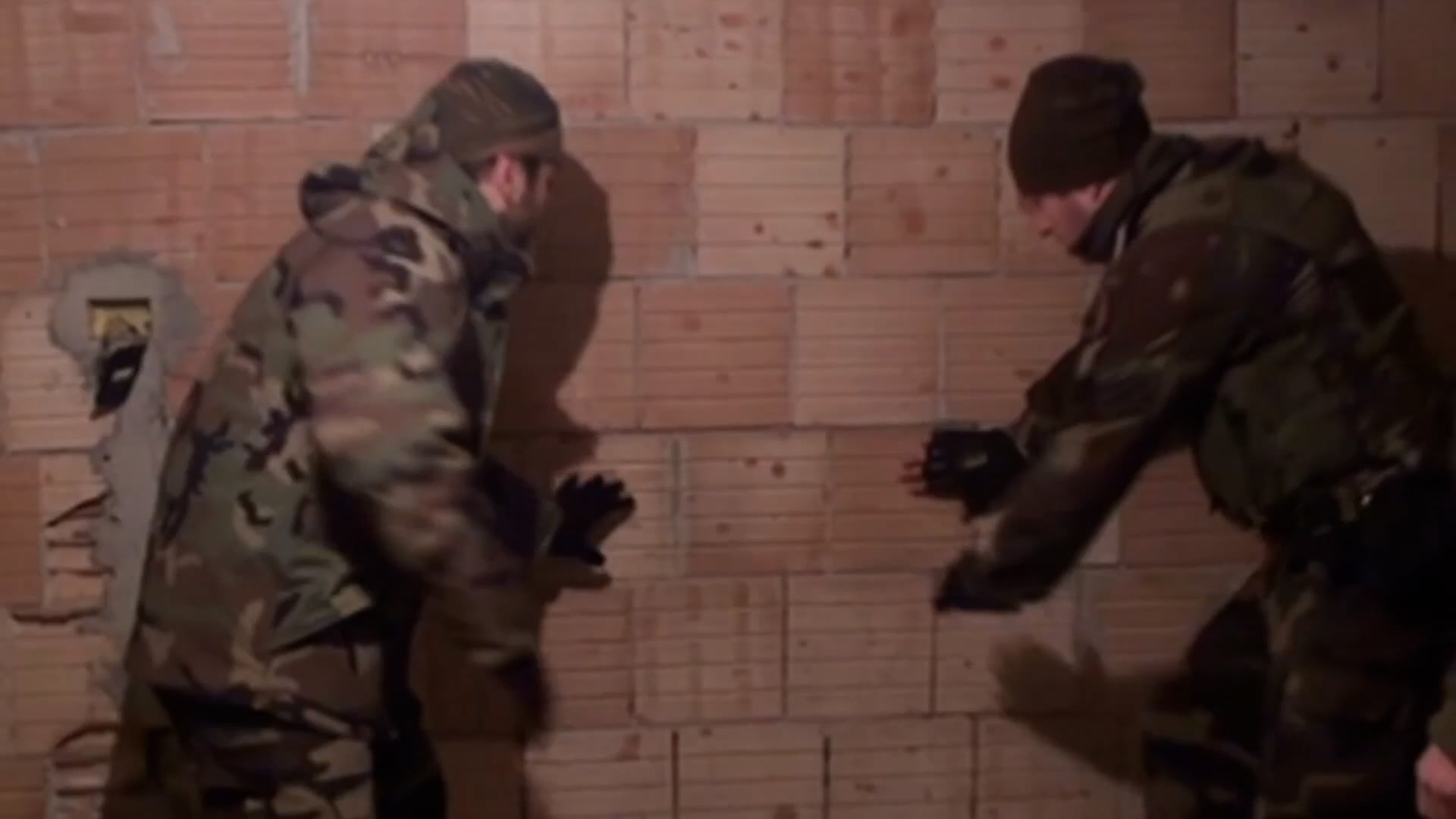
CACCIATORI DI CALABRIA, 2023. VIDEO PROJECTION, 6’20”

la teoria del vuoto
bonaventura imbriaco severo
works
VIEW OF PLATÌ, REGGIO CALABRIA, 2023


la teoria del vuoto
bonaventura imbriaco severo
works

la teoria del vuoto
bonaventura imbriaco severo
installation view
Swarovski telescope, Vibo Valentia, 2023
Inkjet print, 180x144cm

la teoria del vuoto
bonaventura imbriaco severo
installation view
Access shaft to a bunker, Platì, Reggio Calabria, 2015
Inkjet print, 128x160cm
Leatherman, Platì, Reggio Calabria, 2015
Inkjet print, 50x35cm

la teoria del vuoto
bonaventura imbriaco severo
installation view
View of Platì, Reggio Calabria, 2023
3 inkjet prints 180x144cm each

la teoria del vuoto
bonaventura imbriaco severo
installation view
Pietra Cappa, Aspromonte, Reggio Calabria, 2014
Inkjet print, 180x144cm
la teoria del vuoto
bonaventura imbriaco severo
Images, visions and landscapes
How do you see the mafia? Can it be seen, or is it invisible? Is it a secret association that hides, that camouflages itself? Can it be distinguished from the context in which it is present? Or does it overlay the context, having no form of its own? What is the landscape of the mafias? These are some of the questions raised by the theme of how to see the mafia, and therefore of how to represent it, that is to recognise it and also, perhaps even before that, to imagine it. As is well known, the mafia imaginary is very wide, stratified and multiform, fed moreover by persistent stereotypes and commonplaces. The mafia belongs to that category of subjects for which the imaginary counts enormously. The images that evoke the mafia universe exert deep performative effects on the phenomenon, contributing to its constitution and its configuration. This is an imaginary produced by many instruments of creation and channels of representation. Among these, photography obviously has its own peculiarities: it fixes an image, it focuses and draws a perimeter, it selects a perspective, adopting a certain gaze. Capturing an image, moreover, implies an act of construction that requires creativity and, precisely, imagination. It is therefore not a mere reproduction of reality. All this is evident in the project La Teoria del Vuoto, in continuity with the earlier Corpi di Reato. Un’archeologia visiva dei fenomeni mafiosi nell’Italia contemporanea: the authors do not want to reproduce the mafia phenomenon, they do not want to represent it realistically or even symbolically; rather they construct images by crossing plural optics, sequence shots and different levels of scale. The result is a representation I would call «rarefied», whose sense and meaning are not immediately grasped. The phenomenon is not there; the reference is to the context, which is nonetheless not easy to decipher. These are images without a centre, which ask to be carefully observed: to make out the solids and the voids, to find the presence of dividing lines, to understand what is inside and what is left outside, to grasp the «off‑screen», to work out from where and how they were «taken», selected, edited and reconfigured. They are images, it seems to me, produced by a lateral and oblique gaze, an optics that avoids falling into the trap of mafia‑centric visions. The latter are very widespread, but misleading: visions according to which everything seems to depend on what the mafia wants and does, represented as an omnipotent actor both in the areas of original settlement and in those of new expansion. A perspective which in fact helps neither to understand the processes by which the mafias take root in a territory, nor those of their spread, and which paradoxically ends up resembling the well‑known thesis that «everything is mafia, therefore nothing is mafia». An optics, therefore, that fails to take into account that the fundamental question—not only in the South, but in the North as well—concerns in general the relationship between legality and illegality, which appears increasingly marked by opaque and porous boundaries, and more particularly the growing intermingling of the two spheres, whose meeting ground is politics and the economy in their concrete mechanisms of regulation and functioning. The problem of how to see the mafias, of the kind of gaze and of perspective, is naturally important for the social scientist too, and for anyone who sets out to observe, study and indeed recognise the mafia phenomenon. Returning to the questions with which these notes opened, I therefore offer some reflections based on my by now long experience of study, both theoretical and empirical, of the mafias in areas of traditional settlement as well as of more recent expansion. The privileged point of view reflects the sociological imagination that has guided research designs, analyses and interpretations over time.
of the mafia
by Rocco Sciarrone
Seeing and recognising the mafias
Let us start from the problem of recognition, which brings into play the question of «what the mafia is». There is no single, shared answer. We have rather a multiplicity of definitions and representations that have settled over time, produced and conveyed in different areas of public and political debate. It should moreover be borne in mind that the phenomenon of the mafia takes shape and is transformed together with that of the anti‑mafia, and that the processes of hetero‑ and self‑representation through which it concretely manifests itself in a given space–temporal context
are very important.
It is significant to note in recent years the tendency to frame the theme almost
exclusively in terms of public order, essentially in terms of a «criminal
Rocco Sciarrone – Professor of Sociology of the Mafias
at the University of Turin
la teoria del vuoto
bonaventura imbriaco severo
question». It is a one‑dimensional reading that finds ever greater echo and amplification in the public sphere and in the representations conveyed by the mass media. It is, however, a vision with a long tradition behind it: indeed, as early as the aftermath of Italian unification the mafia phenomenon was analysed as the expression of «a world apart, sui generis», becoming the main discursive axis for explaining the problem of the dualism between the North and the South of the country. And yet, coming back to more recent years, when numerous judicial investigations brought to light a strong presence of organised crime and systemic corruption in the regions of central and northern Italy, the prevailing image is that of a South contaminating the part of the country considered more modern, civic and developed, and causing its progressive degeneration. On the other hand, the explanation of organised crime rests mainly on categories such as tradition, the absence of the State, social pathology, relative deprivation. These are categories that belong, in varying degrees, to a «deficit paradigm», according to which the causes of crime are to be traced back to some lack: of control, of income, of socialisation, of opportunity, of rationality and so on. In its more structured forms, as in the case of the mafias, organised crime may however be «an outcome not of a deficit but of a hypertrophy of opportunities; not of underdevelopment but of overdevelopment; not of a lack of status but of a gigantic and uncontrolled production of procedures for acquiring status». For this reason it is important to stress the relevance of the processes of overlapping and hybridisation between the legal and the illegal world: only those groups able to move along the borders of the two worlds can enjoy those multiple social affiliations that increase their opportunities. More generally, in the history of our country the shifting boundaries between the legal and the illegal constitute a fault line running through the economy and politics at various levels, interweaving on many planes.
grasping the interdependence of nodes and connections that hold the criminal network together.
Territorial expansion
While on the one hand the mafia has from its origins been a phenomenon of local society, in that it tends to manifest itself fully within a circumscribed territory, exercising some form of dominion (so‑called control of the territory), on the other hand mafia groups—at least the more structured ones—have always moved on a supra‑local scale, seeking to extend their fields of activity not only with regard to illicit traffics but also with regard to the contexts in which they settle. To underline the expansive danger of the mafias, many observers recall Leonardo Sciascia’s well‑known metaphor of the «palm line» climbing progressively northwards, just as the line of the mafia would advance unstoppably along the peninsula. Sciascia’s image is, however, more refined than it is generally made out to be: it refers not to the palm but precisely to its line, that is to the «climate that is favourable to the vegetation of the palm». It therefore draws attention to the contextual conditions that become more favourable to the birth and growth of this plant further north as well. Moreover, mafia expansion is a multidimensional process, characterised by the combination and interaction of several factors of different kinds. It does not develop in a linear, one‑way fashion: between South and North, between the areas where the mafias historically arose and the areas of new expansion, relations of interdependence and feedback are established instead. As regards the presence of the mafias in the regions of central and northern Italy, the predominant perspective is nonetheless the one that tends to see the spread of mafia groups as a «spontaneous» process, sustained and driven—one might say—by a force intrinsic to this kind of criminality. These are the analyses we can trace back to the contagion thesis: here the mafia is seen as a pathogen that expands without limit, contaminating new territories. It is a thesis that emphasises the danger of the phenomenon, presupposing more or less explicitly that it spreads like a virus attacking a fundamentally healthy tissue. The underlying idea is indeed that of a malign factor, of exogenous origin, attacking and infecting a body in good health. What is entirely overlooked, however, is that if the epidemiological perspective is taken seriously, contagion is determined not so much by an infectious agent as by the culture medium that allows the latter to develop. Nor is it by chance that medical metaphors are so widely used when speaking of the mafia: that of the cancer, for instance, recurs very often. The reference is always to an exogenous element endangering a well‑functioning organism. In certain respects close to this perspective is the idea that the spread of the mafias is a sort of invasion of a new area by specific criminal actors. Here too the image that prevails is that of an external agent invading a territory and trying to conquer it. The expansive process is not attributed to spontaneous transmission, or at any rate to contact with pathogenic elements, but is considered the outcome of an intentional strategy of occupying a new territory. The contagion thesis and that of invasion or conquest nonetheless share the fact that mafia diffusion is represented as an aggression coming from outside against an area that suffers it and falls victim to it, being characterised by the absence of effective antibodies or by an inability to assess the danger and to counter it. Both perspectives display the flaws of that mafia‑centric vision described above, according to which it is always the mafia that decides and acts, almost irrespective of constraints and opportunities. The problem of the territorial spread of the mafias is better understood, instead, if it is considered as the consequence of a process in which the strategies of actors and contextual factors combine and influence one another. In general, institutional arrangements and processes of regulation count for a great deal, above all in the areas where the economy and politics meet. High levels of opacity in the working of institutions, together with particularistic orientations in the management of public resources, are indispensable ingredients for developing relations of collusion and complicity, and fundamental ingredients too for understanding the spread of the mafias in the centre and the north. In this respect, indeed, what counts most is the welcome and the hospitality they have received in the context of arrival.
Social capital and the grey area
The main competences at the disposal of mafiosi concern, on the one hand, the specialised use of violence and, on the other, the ability to manipulate and use social relations, that is to accumulate and employ social capital. They are therefore, at one and the same time, specialists in violence and experts in social relations: they are thus able to build a system of rules founded on coercion and to structure a system of relations based on variable forms of social consent. It is precisely this ability to accumulate and employ social capital, that is to establish «external relations» and to be able to count on a broad and varied reservoir of relational resources usable for many ends, that explains the strength and the persistence of the mafia. The crucial point is that the mafia’s relational system can constitute a form of social capital usable also by people outside the organisation. On the other hand, contrary to what is generally argued in current views of the phenomenon, mafiosi tend for the most part to avoid zero‑sum, winner‑takes‑all games (except, obviously, towards those who set themselves up as, or are perceived as, adversaries). They prefer rather positive‑sum games, in which all the players have something to gain. These «cooperative games» produce selective benefits, in the sense that only those who cooperate can enjoy the resulting advantages, and at the same time—being based on reciprocity—they entail some form of recognition and ultimately of legitimation, encouraging the repetition and the extension of exchanges. It is precisely in these cooperative games that the mechanisms for building the consent the mafia enjoys are grounded, and, together with them,
those that structure the grey area in which its «alliances in the shadows» develop.
Grey area is an evocative expression, an effective image for describing the opaque space in which relations of collusion and complicity with the mafia take shape, involving a wide variety of people, differing in competences, resources, interests and social roles. This area resembles a nebula, that is it has a variable geometry, since it can take very different forms depending on the context and on the kind of actors involved. Within it, mafiosi are not always and not necessarily the dominant actors; often, indeed, the pivot of the relational system turns around outsiders such as businessmen, politicians, public officials, professionals and so on. To throw light on this area one must therefore widen the field of observation, and look beyond the mafia. Focusing attention on mafiosi alone in fact prevents one from
la teoria del vuoto
bonaventura imbriaco severo
Observing processes and grasping ambivalences
distinction can be traced back to a variant of the classic dichotomy between collective and individual interests. The logic of belonging privileges and seeks to protect the interests of the organisation, while that of business favours the interests of individuals. The distinction also recalls the two main objectives the mafias generally pursue: the accumulation of wealth and the pursuit of power. From this point of view too we can identify two different models of action: one entrepreneurial, oriented towards economic profit, the other political, aimed at the exercise of power. The two ends are traditionally combined, even if, depending on the context and the historical period, one may prevail over the other.
The picture outlined so far suggests the usefulness of adopting a processual analytical perspective: like every social phenomenon, the mafia too is not identical to itself in every time and in every place. Yet it is often spoken of without taking into account that it undergoes profound transformations, which moreover affect the various types of criminal organisation and their respective contexts in differing ways. It is important, instead, to grasp lines of continuity and of discontinuity on several planes: at the temporal level (the historical dimension); at the spatial level (the geographical and territorial dimension); at the organisational and functional level (the configuration of mafia networks and of their fields of activity). Mafia groups – albeit with peculiarities varying from one type to another – are characterised by a series of tensions and ambivalences concerning organisational structure, the symbolic apparatus and normative codes, the logics and the modes of action. We may picture these ambivalences as dichotomies or polarities which in concrete cases unfold along a continuum. On the level of organisational structure we find the opposing tendencies towards centralisation and dispersion, towards more vertical or more horizontal models, hierarchical or reticular. These tendencies are found within one and the same type of mafia, besides historically distinguishing its various types. On the cultural and normative level ambivalences of a different nature emerge, as is shown by the use of symbols and rituals that mark entry and the stages of a career within the organisation, especially with reference to the ’ndrangheta. As for rules and codes of conduct, one finds a hypertrophic production of norms accompanied by an equally overabundant sequence of exceptions and by a continual search for expedients to circumvent them or bend them to partisan interests. Another kind of ambivalence can be traced back to the visibility/invisibility dichotomy, which brings us directly back to the question of recognition, particularly evident when the phenomenon is in a phase of «emergence», as happens in areas of new expansion. As is well known, the mafias need to be invisible, being illegal organisations that must escape the repressive action of the police: they therefore constitute themselves as secret associations and invest considerable resources in disguising their activities and concealing their members. At the same time, however, they need to be visible in the territory where they decide to settle permanently or to operate with a certain continuity: some form of visibility is a necessary condition for mafiosi to obtain the social recognition indispensable for building and making effective their own reputation. In areas of high mafia density, those where the presence of these organisations has settled over time, the relation between visibility and invisibility tends to reach a certain balance, so much so that each becomes functional to the other. In non‑traditional areas the situation changes: mafiosi must first of all secure an effective level of invisibility, but at the same time they must make themselves recognisable from outside. They must therefore build a social visibility for themselves without exposing themselves too much and so becoming vulnerable to the agencies that fight them. It is an operation that demands targeted investment in social relations. It is in fact likely that they will seek recognition starting from specific social circles: they must be credible, but above all they must find people on whom they can «get a hold. For this reason, while disguising the illegal activities in which they are engaged, which makes it necessary to set up formally legal activities that can also serve as cover, they cannot do without displaying their logo of belonging. The latter is conveyed and becomes recognisable thanks to the mafia imaginary widely diffused through the mass media and public debate, and manages with relative ease to become a «successful brand» in the new context of expansion too. Recognition of the logo amplifies the mafia reputation, which can be spent as an effective form of accreditation in ever wider circles of local society. Another dichotomy that characterises mafia action is that between the logic of belonging and the logic of business. As in other organisations, in mafia ones too there coexist different criteria orienting the action of the group as a whole and that of the members who belong to it. On the one hand we have an organisational logic aimed at ensuring internal cohesion, bonds of loyalty, the coordination and the cooperation of actors; on the other we have an instrumental logic, aimed at obtaining material advantages and benefits, above all—though not exclusively—of an economic kind. The
With the mafias as a pretext
In the end, the landscape of the mafias appears very complex, made up of a peculiar interweaving of flows of people, goods, capital, information, ideas and images. These flows produce «panoramas» of fluid and irregular shape, within which specific criminalscapes also find room: landscapes formed by actors and activities that lie in the sphere of illegality, on the borders of legality and astride the two spheres: not only the area of crime in the strict sense, therefore, but also that wide grey zone made up—as we have seen—of relations of exchange, collusion and complicity. The images offered in the exhibition Teoria del vuoto seem to me very much in tune with the reflections developed in the preceding pages. I have already stressed that the authors rightly avoid adopting a mafia‑centric perspective, choosing instead an approach of a processual kind. It is a point of view which, besides taking spatial and temporal coordinates into account, crosses—moving between Platì and Buccinasco—a multiplicity of gazes and planes of observation: horizontal and vertical, internal and external, near and far, private and public. Attention is directed not at the mafia phenomenon but above all at the contexts in which it takes shape: the focus is on places, or more precisely on «particular» aspects of places. The photographs often render features of the territory, clues to the environment, signs of social life, which taken together offer an idea—an image—of the landscape in which the mafias are present and in which mafiosi act. But, as I was saying, the mafias and the mafiosi are not there, not even in some form of symbolic transfiguration. In reality, with the mafias as a pretext something else is being shown. This is the crucial point, it seems to me, of the optics—and the poetics—adopted by the authors. Their photographs prompt questions, making clear that it is the questions that matter, far more than the answers. The images set out to interrogate; they must therefore create disorientation, that is encourage a cognitive operation that then leads one to glimpse and recompose the complexity of the landscape. The presence of the mafias is in the background, or rather off‑screen, but it also works as a kind of «filter» that makes the context visible in a certain way. Looked at closely, and not at all obviously, the questions discussed here emerge beneath the surface: those relating, for example, to recognition, to ties, to territorial expansion, to the grey area, to the degree of visibility, to the ambivalences that characterise the mafia phenomenon. Shunning the ready‑made imaginary on the subject, the perspective adopted goes against the current and produces strong effects of displacement. The images offered are the outcome of a gaze that seeks complexity, that wants to observe the zones of contact, of overlap, of boundary, of passage. With the mafias as a pretext we are therefore invited to see a wider and deeper panorama, useful for dismantling the idea of their «unlimited and metahistorical power», that is the myth of their invincibility. Besides, refining and widening the gaze serves not only to understand better, but also to imagine new forms of anti‑mafia, beyond anniversaries, celebrations and heroes.

la teoria del vuoto
bonaventura imbriaco severo
works
VIDEO LINK
OPERATIONS ROOM OF THE LOCAL POLICE, BUCCINASCO, MILAN, 2023. VIDEO PROJECTION 5’00’’
Frames

la teoria del vuoto
bonaventura imbriaco severo
works

la teoria del vuoto
bonaventura imbriaco severo
works

la teoria del vuoto
bonaventura imbriaco severo
OPERATIONS ROOM OF THE LOCAL POLICE, BUCCINASCO, MILAN, 2023. VIDEO PROJECTION 3’55”
la teoria del vuoto
bonaventura imbriaco severo
list of works
1. Via Salieri, Buccinasco, Milan, 2012 Inkjet print, 135x180cm 2. Photographic survey of the perimeter of the area where two M80 rocket launchers were found, Buccinasco, Milan, 2023 2 inkjet prints, 80x110cm each, overall size 200x130cm 3. User manual for the Zolja M80 64mm rocket launcher, Federal Directorate of Supply and Procurement, Yugoslavia, 1982 48 scored inkjet prints, 20x25cm each 4. Drainage channels around the perimeter of the green area between Via Salieri and Via Archimede, Buccinasco, Milan, 2023 94 inkjet prints 18x13cm, overall size 135x185cm 5. Buccinasco, Archivio dello Spazio, 2023 9 inkjet prints 12x75cm and 12x60cm, 2 works measuring 81x110cm each 7. Playground of the Spina Verde Park, Buccinasco, Milan, 2012 2 inkjet prints, approx. 200x140cm 8. Reconstruction of the Spina Verde playground made from 1604 photographic surveys in plan, Buccinasco, Milan, 2023 110 Xerox prints 36.5x28cm, overall size 338x405cm 9. Via della Resistenza, Buccinasco, Milan, 2023 4 inkjet prints of various sizes, overall size 60x50cm 10. Environment and Land Control Department, Buccinasco, Milan, 2023 Inkjet print 10. Payment reminder signed by Rosario Barbaro addressed to the Municipality of Buccinasco, Milan, 2023 Inkjet print, 29.7x21cm 11. Mowing of the meadow of Via della Resistenza, Buccinasco, Milan, 2023 Video projection, 19′14′′ 12. Files containing the documentation relating to the meadow of Via della Resistenza, Buccinasco, Milan, 2023 2 inkjet prints, 75x100cm each 13. Garage unit at Via Aldo Moro n. 8, Buccinasco, Milan, 2023 Inkjet print, 32x46cm 14. View from the house of Antonio Papalia, Buccinasco, Milan, 2023 Inkjet print, 128x160cm 15. View from the villa of the Papalia clan, Platì, Reggio Calabria, 2014 Inkjet print, 128x160cm (to be produced) 16. Swarovski telescope, Vibo Valentia, 2023 Inkjet print, 180x144cm 17. Access shaft to a bunker, Platì, Reggio Calabria, 2015 Inkjet print, 128x160cm 18. Leatherman, Platì, Reggio Calabria, 2015 Inkjet print, 50x35cm 19. View of Platì, Reggio Calabria, 2023 3 inkjet prints 180x144cm each 20. Pietra Cappa, Aspromonte, Reggio Calabria, 2014 Inkjet print, 180x144cm 21. Operations Room of the Local Police, Buccinasco, Milan, 2023 Video projection, 5′ 22. Cacciatori di Calabria, 2023. Video projection, 6′20″
